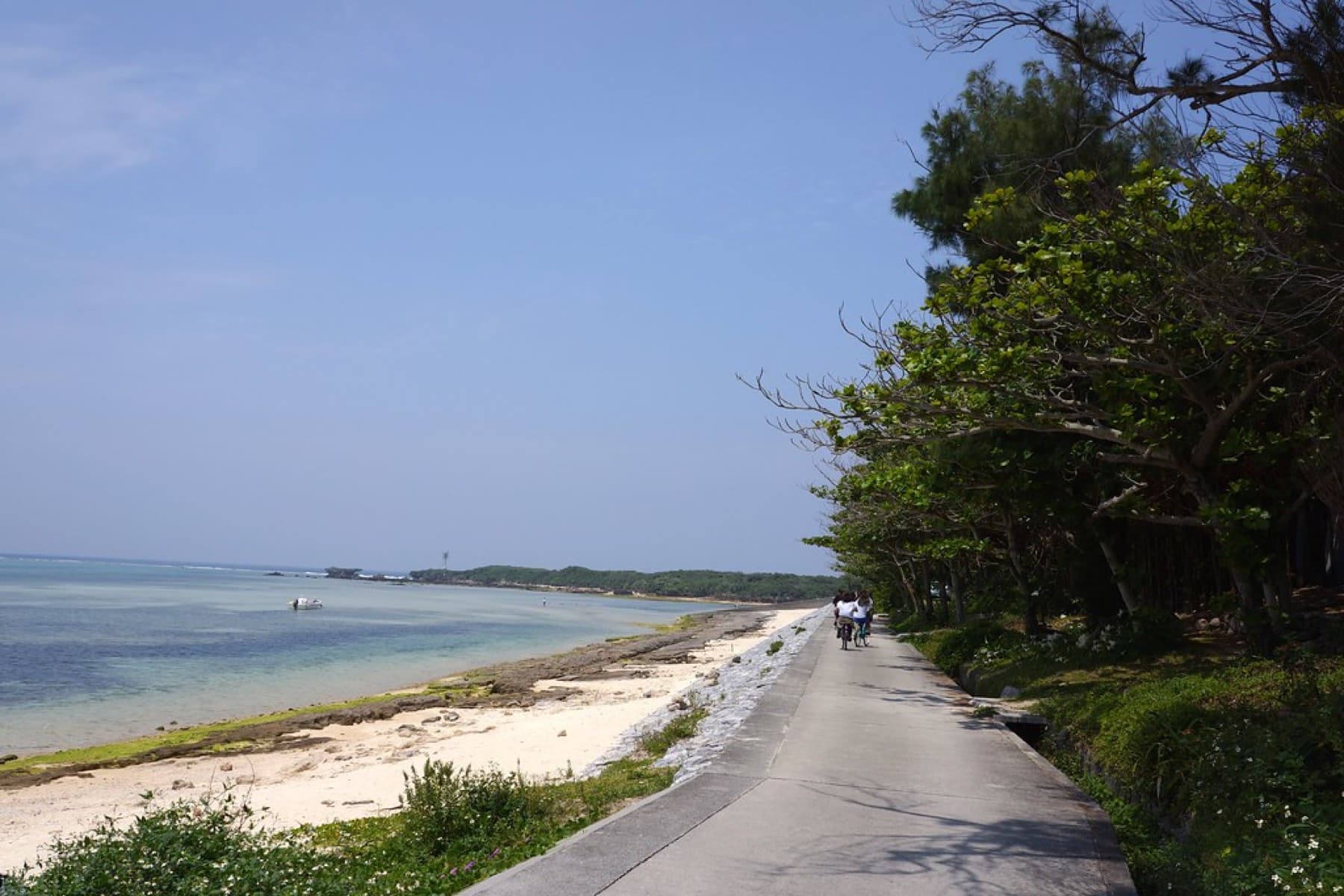
Nago
名護26°36′ N 127°58′ EJMA1991-202019.4 to 21.5 °C
Table view
| Month | High °C | Low °C | Mean °C | Sea °C | Rain mm | Rain days | Sun h | Humidity % | Wind | m/s |
|---|---|---|---|---|---|---|---|---|---|---|
| Jan | 19.4 | 13.7 | 16.5 | 22.2 | 96.8 | 11.3 | 94.7 | 69 | N | 3.8 |
| Feb | 19.8 | 13.9 | 16.8 | 21.5 | 109.9 | 10.7 | 91.4 | 71 | NNE | 3.8 |
| Mar | 21.5 | 15.6 | 18.5 | 21.7 | 140.8 | 11.4 | 112.6 | 73 | NNE | 3.7 |
| Apr | 24 | 18.2 | 20.9 | 22.8 | 160.8 | 10.6 | 121.3 | 76 | NNE | 3.5 |
| May | 26.7 | 21.2 | 23.8 | 24.5 | 220.1 | 11.9 | 136.7 | 79 | NNE | 3.2 |
| Jun | 29.5 | 24.9 | 26.9 | 26.7 | 291.7 | 12.2 | 152.3 | 83 | S | 3.8 |
| Jul | 31.9 | 26.7 | 28.9 | 28.9 | 182.6 | 10.4 | 235.7 | 79 | S | 3.7 |
| Aug | 31.9 | 26.4 | 28.8 | 29.1 | 265.9 | 12.4 | 211.9 | 79 | SE | 3.7 |
| Sep | 30.8 | 25.1 | 27.6 | 28.4 | 238.4 | 12.4 | 183.4 | 77 | NNE | 3.7 |
| Oct | 28 | 22.5 | 25 | 26.8 | 184.7 | 9.6 | 166.2 | 74 | NNE | 4.1 |
| Nov | 24.8 | 19.3 | 21.9 | 25.1 | 119.2 | 9.1 | 124.5 | 71 | NNE | 3.9 |
| Dec | 21.1 | 15.6 | 18.2 | 23.5 | 109.7 | 10.7 | 108 | 69 | NNE | 3.9 |
Reading the seasons
Station
JMA's Nago observatory (block 47940) stands 6.2 m above sea level in Nago city. Every figure in this file is JMA's published 1991–2020 normal, and rain days count the days with 1 mm or more.
Winter
Nago's winter wind blows most often from the north-north-east, or from due north in January, at an average of 3.7–3.9 m/s from December to March. That sits well below Naha's average, and the day's strongest wind reaches 10 m/s on only about 2 days a month in that stretch. Nights run cooler than in Naha, with January lows averaging 13.7 °C. February brings 109.9 mm of rain over 10.7 days and a high averaging 19.8 °C.
Spring
In early spring a low from the East China Sea sometimes deepens fast as it crosses Okinawa. Once its cold front passes, a southerly wind swings round to a strong north or north-east wind and the temperature drops. Okinawans have long called this *ningwachi kajimaai* (the wind turn of the second lunar month).
Summer
When the rainy season ends in late June the Pacific high pushes west and a strong south to south-west wind called *kaachiibee* blows steadily for several days. Nago's most frequent wind in June and July comes from due south.
Typhoon
JMA counts a typhoon as approaching the Okinawa region when its centre comes within 300 km of a station there, and the 1991–2020 normal is 7.7 approaches a year. August averages 2.2 approaches and September 1.9. Across those 30 years JMA recorded no approach at all from January to March.
Rainy
JMA's 1991–2020 average puts the start of Okinawa's rainy season around 10 May and its end around 21 June. JMA's preliminary dates for 2026 were around 4 May and around 29 June. Okinawans call the season *suuman boosuu* after two of the old solar terms that fall inside it.
Sea
Sea temperatures are our monthly averages of JMA's daily 1991–2020 sea surface normals at its fixed point north-west of Okinawa Island (沖縄本島北). The monthly figure runs from 21.5 °C in February up to 29.1 °C in August.
Wind
The windDir field holds JMA's most frequent wind direction (最多風向) for each month as the 16-point compass point the wind blows from.
Quick answers about Nagoよくある質問
What is the weather like in Nago in January to March?
In January to March, Nago averages daily highs of 19.4 to 21.5 °C and lows of 13.7 to 15.6 °C, with 97 to 141 mm of rain a month, by the Japan Meteorological Agency's 1991-2020 normals. The most frequent wind in January comes from the N at a mean 3.8 m/s.
Which month is warmest in Nago?
July is the warmest month in Nago, with an average daily high of 31.9 °C, by the Japan Meteorological Agency's 1991-2020 normals.
Which month is wettest in Nago?
June is the wettest month in Nago, with 291.7 mm of rain on average, by the Japan Meteorological Agency's 1991-2020 normals.
In the journal