guide · 7 min read
What is winter riding like on Okinawa's outer islands?
From December to March JMA's 1991–2020 normals give Miyako, Ishigaki, Iriomote, Hateruma and Yonaguni daily highs of 20–24 °C and lows of 16–19 °C, a north-northeasterly averaging 4–6 m/s (7–8 m/s on Yonaguni), 10–16 rainy days a month and seas near 23 °C.
By Ride Okinawa · Updated 2026-10
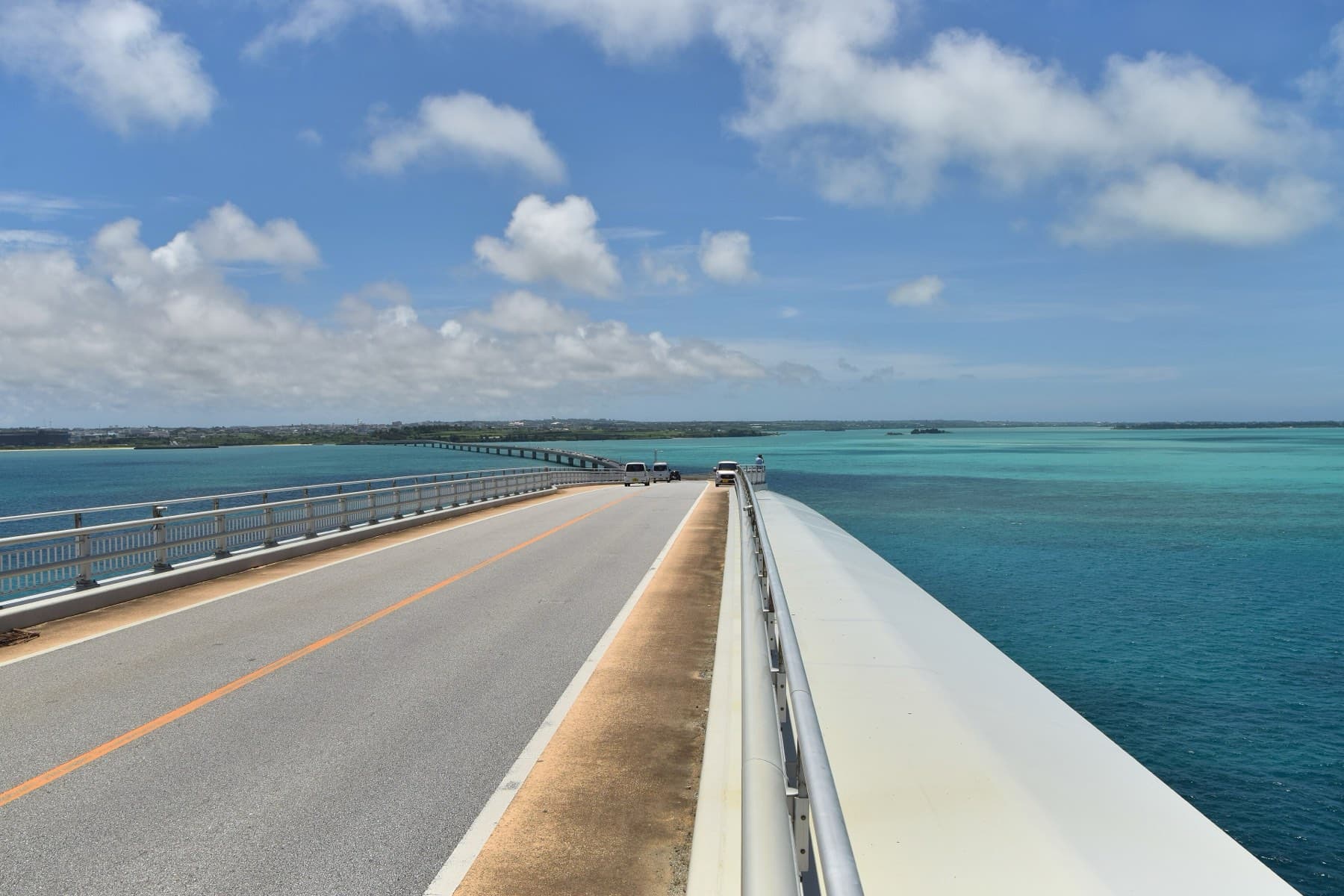
Winter on the outer islands is mild riding weather with a steady wind attached. From December to March, the Japan Meteorological Agency's 1991–2020 normals give the stations on Miyako, Ishigaki, Iriomote, Hateruma and Yonaguni daily highs of 20.6 to 23.8 °C and overnight lows of 16.3 to 18.7 °C, with January the coolest month. The winter monsoon blows from the north-northeast at most stations and averages 4.2 to 5.7 m/s, and on Yonaguni it averages 6.9 to 8.2 m/s and reaches 10 m/s on 17 to 22 days a month. Rain falls on about 10 to 16 days a month. By our calculation mid-February brings about 11 hours 20 minutes of daylight, and JMA's sea-area normals sit around 23 °C in February. Yoron, farther north, runs about 2 °C cooler than the Yaeyama stations.
All the figures below are JMA normals for 1991–2020 unless a note says otherwise. Miyakojima, Ishigakijima, Iriomotejima and Yonagunijima are full weather stations. Hateruma and Yoron are smaller automatic (AMeDAS) stations that record fewer things, and Yoron's temperature record covers only 2000–2020.
How warm is it from December to March?
Daily high and low in °C:
| Station | December | January | February | March |
|---|---|---|---|---|
| Miyakojima | 22.2 / 18.2 | 20.6 / 16.3 | 21.1 / 16.6 | 22.8 / 17.9 |
| Ishigakijima | 23.0 / 18.4 | 21.5 / 16.7 | 22.0 / 17.2 | 23.7 / 18.6 |
| Iriomotejima | 22.4 / 17.9 | 20.9 / 16.4 | 21.6 / 16.7 | 23.1 / 17.7 |
| Hateruma | 22.9 / 18.7 | 21.5 / 17.0 | 22.1 / 17.4 | 23.8 / 18.7 |
| Yonagunijima | 22.2 / 18.2 | 20.7 / 16.6 | 21.3 / 17.0 | 23.0 / 18.3 |
| Yoron (2000–2020) | 20.9 / 16.3 | 19.1 / 14.3 | 19.8 / 14.9 | 21.1 / 15.9 |
The spread across the Miyako and Yaeyama stations is about 1 °C in any month, so the island you pick changes the wind you'll ride in far more than the temperature. Yoron sits nearly 3 degrees of latitude farther north and feels it, with February nights near 15 °C. Relative humidity at the four full stations runs 71 to 77% through the season.

How strong is the winter wind, and which way does it blow?
Mean wind speed in m/s, the most frequent direction, and the average number of days each month when the day's strongest 10-minute wind reached 10 m/s:
| Station | Dec | Jan | Feb | Mar | Most frequent direction | Days reaching 10 m/s (Dec, Jan, Feb, Mar) |
|---|---|---|---|---|---|---|
| Miyakojima | 5.3 | 4.9 | 4.8 | 4.6 | North-northeast | 4.8, 3.0, 2.6, 2.6 |
| Ishigakijima | 5.6 | 5.3 | 5.4 | 5.2 | North-northeast | 4.7, 3.7, 3.8, 4.0 |
| Iriomotejima | 4.8 | 4.6 | 4.6 | 4.2 | Northeast | 4.5, 4.9, 4.1, 4.0 |
| Hateruma | 5.7 | 5.5 | 5.4 | 5.0 | Not recorded | Not recorded |
| Yonagunijima | 8.2 | 7.9 | 7.6 | 6.9 | North-northeast | 21.7, 21.7, 18.8, 17.2 |
| Yoron (2000–2020) | 5.9 | 5.9 | 5.6 | 5.6 | Not recorded | Not recorded |
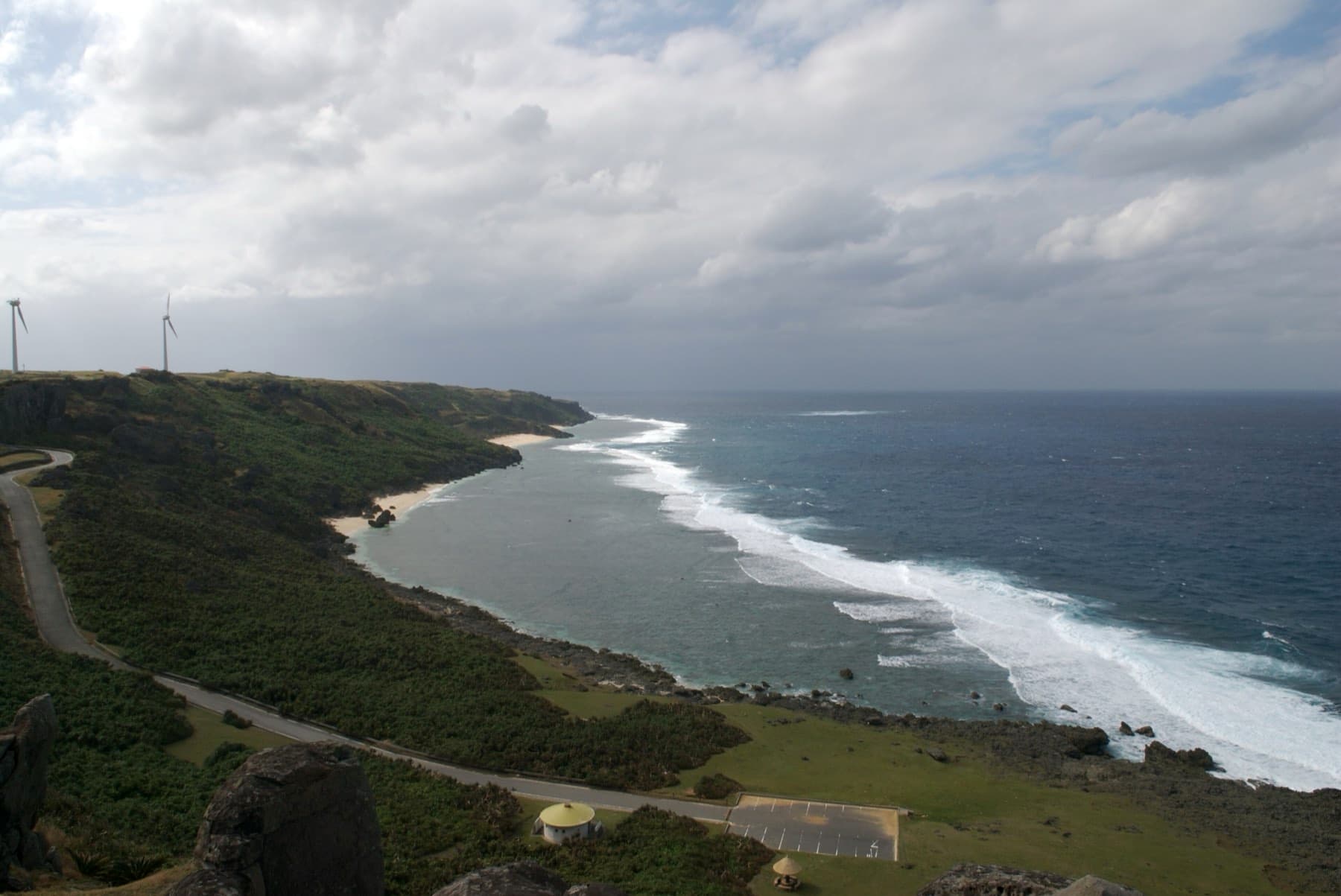
This is the northeasterly winter monsoon, and on most of the islands it means a ride of two halves: a long grind on the legs heading north or east and a fast run home. Plan loops so the upwind leg comes first, and ride out-and-backs out into it. Yonaguni stands apart. Its station sits at the western end of the chain and averages nearly 8 m/s in December and January, with the wind reaching 10 m/s on most days of the month, and an e-bike or a short ride plan makes sense there.
Station winds are measured on open sites, and JMA doesn't publish wind for individual bridges or capes. Expect the long bridges on Miyako and the capes to feel stronger than the table, and the lanes between the coral walls of Taketomi's village to feel calmer.
How often does it rain?
Rainfall in mm, then the average number of days with 1 mm or more:
| Station | Rain: Dec, Jan, Feb, Mar (mm) | Days with 1 mm or more: Dec, Jan, Feb, Mar |
|---|---|---|
| Miyakojima | 147.2, 138.8, 119.8, 138.7 | 11.9, 12.3, 10.8, 10.9 |
| Ishigakijima | 155.2, 135.0, 124.0, 134.4 | 12.3, 12.3, 9.8, 9.7 |
| Iriomotejima | 176.9, 162.9, 146.6, 147.3 | 13.5, 14.1, 12.0, 12.0 |
| Hateruma | 128.0, 119.6, 101.4, 114.9 | Not recorded |
| Yonagunijima | 200.8, 187.2, 163.6, 163.7 | 15.7, 15.8, 13.6, 13.4 |
| Yoron | 91.6, 86.4, 98.9, 140.9 | Not recorded |
Days with 10 mm or more are fewer, about three to six a month at the four full stations, so most wet days bring less than 10 mm. February is the driest of the four months at Miyako by both measures, and at Ishigaki by rainfall. Iriomote and Yonaguni are wetter, and Yonaguni gets rain on about half the days in December and January. Happy Pedal on Ishigaki and Rakuni Koto on Yonaguni waive cancellation fees for bad weather, and Miyako's mobile mechanic Aoyagi Cycle doesn't work on rainy days.


How much daylight and sunshine is there?
Sunrise and sunset by our calculation, using the standard NOAA sunrise equation in Japan Standard Time. For Naha on 1 February 2027 the same method gives 7:14 and 18:12, matching the National Astronomical Observatory of Japan's published times to the minute; NAOJ doesn't publish tables for these islands.
| Place | 21 December | 15 January | 15 February | 15 March |
|---|---|---|---|---|
| Hirara, Miyako-jima | 7:19–17:55 | 7:25–18:11 | 7:14–18:33 | 6:49–18:48 |
| Ishigaki city | 7:22–18:00 | 7:29–18:16 | 7:18–18:38 | 6:53–18:52 |
| Hateruma | 7:23–18:02 | 7:30–18:18 | 7:19–18:40 | 6:55–18:54 |
| Sonai, Yonaguni | 7:27–18:04 | 7:34–18:21 | 7:22–18:42 | 6:58–18:57 |
| Chabana, Yoron | 7:11–17:37 | 7:17–17:54 | 7:04–18:18 | 6:37–18:35 |
Japan runs one time zone, so the sun comes up late this far west, and winter rides start in the dark before about 7:15. The upside is light until about 18:30 in mid-February. Winter sunshine is limited, with February normals of 90.3 hours at Miyakojima, 91.3 at Ishigakijima, 82.9 at Iriomotejima, 97.8 at Hateruma and 60.3 at Yonagunijima. Yoron's station doesn't record sunshine.

How warm is the sea?
Monthly means we calculated from JMA's daily 1991–2020 sea-surface normals for each coastal sea area, in °C:
| JMA coastal sea area | December | January | February | March |
|---|---|---|---|---|
| South of Miyako-jima | 24.6 | 23.5 | 23.0 | 23.3 |
| North of Ishigaki | 24.5 | 23.5 | 23.2 | 23.7 |
| South of Ishigaki | 24.7 | 23.7 | 23.4 | 23.7 |
| South of Yonaguni | 24.8 | 23.9 | 23.7 | 24.3 |
| Southwest Amami coast, the nearest area to Yoron | 23.4 | 22.0 | 21.3 | 21.3 |
These are averages over each sea area, out past the reef. February is the coolest month everywhere, and the Yaeyama areas stay above 23 °C. Shallow lagoons inside the reef can differ from these figures, and JMA doesn't publish them.
Which coasts are sheltered from the north wind?
With the wind from the north-northeast or northeast, the south- and west-facing shores sit in its lee and the north tips and bridges take it in full. That reasoning comes from the wind direction, since JMA publishes no wind data for individual coasts. On Ishigaki the town side on the south coast is the sheltered one, and on Kohama the south and west shores look across calm water toward Iriomote. Taketomi's beaches at Kondoi and Kaiji face west, away from the wind. The ferries make the same point: in winter the boats to Uehara on Iriomote's north coast cancel far more often than those to Ohara on the southeast coast, and Ohara usually stays open.

What should you wear for winter riding?
Dress for 16 to 24 °C with a steady wind. A short-sleeve jersey with arm warmers and a wind vest covers most days, a packable rain shell handles the showers, and knee warmers help on a 7:00 start in January. Pack a light layer for the ferry deck and for long descents on Ishigaki and Yonaguni. On a clear day the sun still has heat in it by noon, so carry sunscreen.
Does the winter wind cancel the ferries?
Yes, on some routes. Ishigaki TripAssist puts the chance of cancellation from December to February at about 50% on the routes to Uehara on Iriomote and to Hateruma, and says the other Yaeyama routes rarely cancel. When the Uehara boats stop, Ohara usually stays open and the ferry companies run a free bus from Ohara to Uehara. Build a spare day into any plan that depends on Hateruma or Uehara, and see the island-by-island guide for which boats carry bikes.
Which data could we not find?
JMA keeps no weather station on Taketomi, Kohama or Kuroshima, so for those islands use Ishigakijima and Iriomotejima as the nearest guides. JMA's normals for the Hateruma station give no rain-day counts, wind direction or humidity. Yoron's give rain days and wind direction but no humidity or sunshine, and its temperature normals start in 2000. NAOJ publishes no sunrise tables for these islands, so the daylight figures are our calculation. JMA's sea temperatures are sea-area averages, and none of its areas matches Yoron exactly. We found no measured wind data for the bridges or capes that riders cross.

We write from operators’ and agencies’ own pages, open map data and published research, and we date every fact we check. How we research.
Sources (25)
- https://www.data.jma.go.jp/stats/etrn/view/nml_sfc_ym.php?prec_no=91&block_no=47927&year=&month=&day=&view=
- https://www.data.jma.go.jp/stats/etrn/view/nml_sfc_ym.php?prec_no=91&block_no=47927&year=&month=&day=&view=a1
- https://www.data.jma.go.jp/stats/etrn/view/nml_sfc_ym.php?prec_no=91&block_no=47927&year=&month=&day=&view=a3
- https://www.data.jma.go.jp/stats/etrn/view/nml_sfc_ym.php?prec_no=91&block_no=47918&year=&month=&day=&view=
- https://www.data.jma.go.jp/stats/etrn/view/nml_sfc_ym.php?prec_no=91&block_no=47918&year=&month=&day=&view=a1
- https://www.data.jma.go.jp/stats/etrn/view/nml_sfc_ym.php?prec_no=91&block_no=47918&year=&month=&day=&view=a3
- https://www.data.jma.go.jp/stats/etrn/view/nml_sfc_ym.php?prec_no=91&block_no=47917&year=&month=&day=&view=
- https://www.data.jma.go.jp/stats/etrn/view/nml_sfc_ym.php?prec_no=91&block_no=47917&year=&month=&day=&view=a1
- https://www.data.jma.go.jp/stats/etrn/view/nml_sfc_ym.php?prec_no=91&block_no=47917&year=&month=&day=&view=a3
- https://www.data.jma.go.jp/stats/etrn/view/nml_sfc_ym.php?prec_no=91&block_no=47912&year=&month=&day=&view=
- https://www.data.jma.go.jp/stats/etrn/view/nml_sfc_ym.php?prec_no=91&block_no=47912&year=&month=&day=&view=a1
- https://www.data.jma.go.jp/stats/etrn/view/nml_sfc_ym.php?prec_no=91&block_no=47912&year=&month=&day=&view=a3
- https://www.data.jma.go.jp/stats/etrn/view/nml_amd_ym.php?prec_no=91&block_no=1354&year=&month=&day=&view=
- https://www.data.jma.go.jp/stats/etrn/view/nml_amd_ym.php?prec_no=88&block_no=1277&year=&month=&day=&view=
- https://www.data.jma.go.jp/stats/etrn/select/prefecture.php?prec_no=91&block_no=&year=&month=&day=&view=
- https://www.data.jma.go.jp/kaiyou/data/db/kaikyo/series/engan/engandata_OK.html
- https://www.data.jma.go.jp/kaiyou/data/db/kaikyo/series/engan/txt/area706-stat.txt
- https://www.data.jma.go.jp/kaiyou/data/db/kaikyo/series/engan/txt/area707-stat.txt
- https://www.data.jma.go.jp/kaiyou/data/db/kaikyo/series/engan/txt/area708-stat.txt
- https://www.data.jma.go.jp/kaiyou/data/db/kaikyo/series/engan/txt/area709-stat.txt
- https://www.data.jma.go.jp/kaiyou/data/db/kaikyo/series/engan/txt/area618-stat.txt
- https://eco.mtk.nao.ac.jp/koyomi/dni/2027/s4802.html
- https://ishigaki-tripassist.com/en/ferry
- https://happy-pedal.jp/faq/
- https://www.aoyagicycle.com/
Related