guide · 7 min read
How should you drink awamori in Naha, and where?
Okinawans drink everyday awamori mizuwari with dinner, and aged kusu comes neat in a small cup. Naha's awamori bars and the lanes of Sakaemachi Market pour both, and distilleries from Shuri to Nago let you taste at the source.
By Ride Okinawa · Updated 2026-10
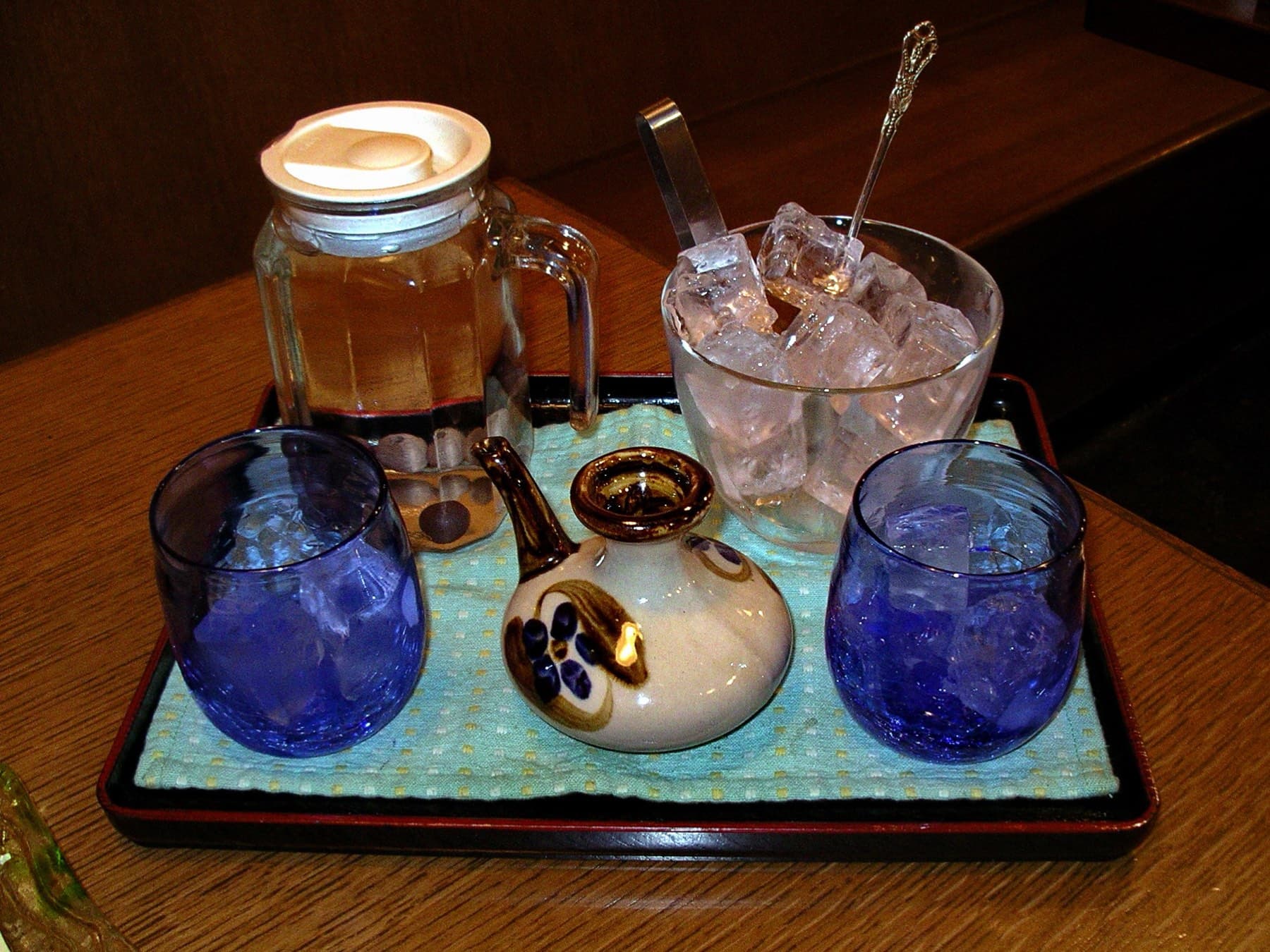
Drink everyday awamori with your food as mizuwari (水割り), with water over ice. When the plates are cleared, a small cup of neat kusu (aged awamori) ends the night the way Okinawa's old households drank it. Okinawa's distillers' association says most standard awamori is bottled at 30%, and a mizuwari brings it down close to the strength of wine or sake, so the association recommends it with food (Okinawa awamori distillers' association). In Naha, the bars between Kumoji and Maejima pour hundreds of labels between them, and Sakaemachi Market by Asato Station fills with drinkers from about 17:00.
We read the distillers' association's guides to drinking and ageing awamori, the bars' and distilleries' own pages, Mapple's March 2025 prices and dated Tabelog reviews in October 2026.
What is awamori, and what makes it kusu?
Awamori is Okinawa's rice spirit. Distillers turn all of the rice into koji with Okinawa's black koji mould, then ferment it and run it once through a pot still. The rice is usually long-grain rice from Thailand. The association lists 47 distilleries across the prefecture.
Kusu (古酒) is aged awamori. Since 1 August 2015 a bottle may carry the word only if every drop in it has aged three years or more, and an age on the label has to be true of the youngest spirit in the blend (association, definition of kusu). Before that, a bottle needed only a little over half its contents aged to pass as kusu, so a bottle filled before August 2015 can still wear the old label. Families kept kusu alive for generations by shitsugi. They drew a cup from the oldest jar and topped it up from the next oldest, and so on down the row (association, shitsugi).

How do you order it?
Name the bottle and how you want it. Tell the staff what you like and an awamori bar will pick a bottle for you, and asking nan-nen-mono desu ka? (何年ものですか, How many years old is it?) gets you the age of a kusu before you commit.
| How it comes | What you get | When to order it |
|---|---|---|
| Mizuwari (水割り) | Awamori over ice, stirred, then topped with water | With dinner, any standard 30% awamori |
| Half and half, no ice | Awamori and room-temperature water at 1:1 | To taste the aroma of a standard bottle |
| On the rocks (ロック) | Kusu over a large cube | Kusu up to about ten years old |
| Neat (ストレート) | A small pour in a chibuguwa cup, with water on the side | Kusu of ten years and older |
| Oyuwari (お湯割り) | Cut with hot water, served lukewarm for strong bottles | A cold February night |
Source: the distillers' association's guides to mizuwari and kusu served neat, read October 2026.
The association has firm views on the mizuwari. Pour the awamori over ice to about halfway up the glass and stir it hard before any water goes in. Some people give it twenty turns. Then add the water and stir again. Hard water makes a light mizuwari taste sharp, and soft water suits a stronger one.
Kusu is for sipping. The association says to sip it slowly from a small pour, and to let a cup of kusu aged 20 years or more sit for 10–20 minutes before you drink. Most kusu runs at 40% or more. The cup the old households used for it was the chibuguwa, smaller than your thumb. Neat awamori traditionally comes poured from a kara-kara jug of Tsuboya pottery.
Which awamori bars should you try in Naha?
Start in Kumoji and Maejima, where the bars sit a short walk from Kencho-mae and Miebashi stations.
| Bar | Area | Hours | Closed | What it costs |
|---|---|---|---|---|
| Karakara to Chibuguwa | Kumoji | 18:00–24:00 | Sundays | Shurei three-year kusu ¥1,800 a gō; standard awamori ¥1,000 a gō; cover dish ¥500 (Mapple, March 2025) |
| Shima Bar AWAMORI+ | Maejima | 19:00–02:00 | Sundays | Tamayuki ten-year kusu ¥1,100 a glass (Tabelog, November 2025) |
| Awamori Soko | Kume | 18:00–24:00 | Sundays and posted days | All-inclusive course ¥7,700, booked three days ahead (bar's site, 2026) |
| Urizun | Sakaemachi | 17:30–24:00 | Open daily | House kusu aged 12 years ¥1,604; Mizuho awamori ¥951 (Mapple, March 2025) |
Mapple says the three awamori meisters at Karakara to Chibuguwa keep about 100 labels from every distillery in the prefecture. Shima Bar AWAMORI+ has 16 seats about 60 m from Miebashi Station, and Tabelog reviewers say the staff explain each bottle as they pour. Awamori Soko holds more than 800 awamori and runs as a members' bar. Visitors book ahead by phone or LINE.
For food with your awamori, go to Urizun. It has cooked Okinawan home and court dishes since 1972, and it ages its own kusu in clay jars. Kumoji's Yunangi dates from 1970 and takes no bookings, so get there near its 17:00 opening.

What is Sakaemachi Market like after dark?
Sakaemachi Market is a warren of covered lanes about 150 m from Asato Station, and its produce and deli stalls close around 18:00 as the bars open between 16:00 and 17:00 (Rurubu, July 2023). Rurubu counted about 120 shops packed under the roof. The evening drinking began around 20 years ago, and Rurubu credits it to Benriya Yuriron. The gyoza counter started out as a deli and now opens 17:00–23:00 except Sundays, and Rurubu priced ten pan-fried gyoza at ¥770 in 2023. Seikatsu no Gara squeezes a handful of stools around a counter from 18:00 to 01:00 except on Tuesdays. Smoking is allowed. Urizun stands at the market's edge.
Most of the small bars have no toilet, and Rurubu points you to the two public toilets in the market. The shopkeepers run a street festival on the last Saturday of the month through the summer and autumn (Ryukyu Shimpo, March 2025). The market grew in the 1950s on the ground in Asato where the prefectural First Girls' High School and the women's division of the Normal School stood before the war. On 23 March 1945, 222 of their students and 18 teachers left for the army hospital at Haebaru. After the war the girls became known as the Himeyuri Student Corps, and the Himeyuri Monument in Itoman marks the cave where many of them died.
The map
Every place in this piece, on its island.
Contours from AWS Terrain Tiles; reefs and coast from OpenStreetMap.
Which distilleries can you visit from Naha?
Zuisen Distillery is the easy one. It stands two minutes' walk from Shuri Castle's Keiseimon gate, and inside a free film with English subtitles tells its story while the counter pours free tastings of its kusu. The shop opens 9:00–17:00, and Zuisen takes visitors on weekdays until 16:30 and on Saturdays until 16:00, with no visits on Sundays or public holidays (Zuisen). The house was founded in Shuri in 1887.
Chuko Distillery runs its Kusu no Mori Chuko-gura in Tomigusuku, about ten minutes by car from Naha Airport. It opens 9:00–17:30 and closes on Thursdays and New Year's Day. Guides take visitors round the hand-made awamori line and the kusu cellar at 10:00 and 14:00 (Chuko). Chuko asks everyone to book, and groups of ten or more must. The shop sells bottles you can only buy there, and the airport is close enough to make it a last stop before a flight.
Further south, the Masahiro gallery in Itoman lets you look into the plant and taste its kusu for free every day except 30 December to 3 January. Helios Distillery makes its Kura kusu at Kyoda in Nago, near the Kyoda Interchange of the Okinawa Expressway. Check tour times with Helios before you go, since we couldn't read them on its site in October 2026. In Naha you can drink its beer and rum at Helios Pub on the second floor of Palette Kumoji, open 11:00–23:00 (Tabelog).
Culture
Awamori
Awamori is Okinawa's own distilled spirit, made from long-grain Thai rice that is turned wholly into black-koji rice, fermented once and distilled once in a pot still. Aged awamori is called kusu, and since August 2015 only spirit aged three years or more in…
- Kind
- Practice
Can you ride a bike after drinking awamori?
No. Since 1 November 2024 riding a bicycle over the drink-driving limit carries up to three years in prison or a ¥500,000 fine, and the person who lends you the bike faces the same (Okinawa Prefectural Police). Whoever served you the drinks faces up to two years or a ¥300,000 fine. Plan the distillery day for a rest day and take the monorail home from the bars.
Quick answers
What is the best way to drink awamori?
Okinawa's distillers' association recommends mizuwari for drinking with food, and that means awamori with water over ice. Most standard awamori is bottled at 30%, and the mizuwari brings it close to the strength of wine. Aged kusu of ten years or more is best neat, in small sips.
What is the difference between awamori and kusu?
Kusu is aged awamori. Since 1 August 2015 an Okinawan bottle can be labelled kusu only if all of the awamori in it has aged three years or more, and a stated age refers to the youngest spirit in the blend.
When does Sakaemachi Market open for drinking?
Sakaemachi Market's bars and counters open between about 16:00 and 17:00 and run until 23:00 or midnight, Rurubu reported in 2023. The market is about 150 m from Asato Station on the Yui Rail.
Can you visit an awamori distillery in Naha?
Yes. Zuisen Distillery in Shuri stands two minutes on foot from Shuri Castle's Keiseimon gate, and it shows a free film and pours free tastings of kusu. Chuko Distillery runs guided tours at 10:00 and 14:00 in Tomigusuku, about ten minutes by car from Naha Airport.
We write from operators’ and agencies’ own pages, open map data and published research, and we date every fact we check. How we research.
Sources (13)
- https://okinawa-awamori.or.jp/enjoy/drink/mizuwari/
- https://okinawa-awamori.or.jp/enjoy/drink/straight/
- https://okinawa-awamori.or.jp/kusu/heirloom/define/
- https://okinawa-awamori.or.jp/enjoy/aging/shitsugi/
- https://www.mapple.net/article/51439/
- https://tabelog.com/en/okinawa/A4701/A470101/47026691/dtlrvwlst/B517592134/
- http://www.awamorisouko.jp/
- https://rurubu.jp/andmore/article/17967
- https://ryukyushimpo.jp/news/region/entry-4044960.html
- https://www.zuisen.co.jp/
- https://www.chuko-awamori.com/chukogura/
- https://tabelog.com/en/okinawa/A4701/A470101/47033786/
- https://www.police.pref.okinawa.jp/docs/2024102100046/file_contents/R6_pos_01.pdf
Related